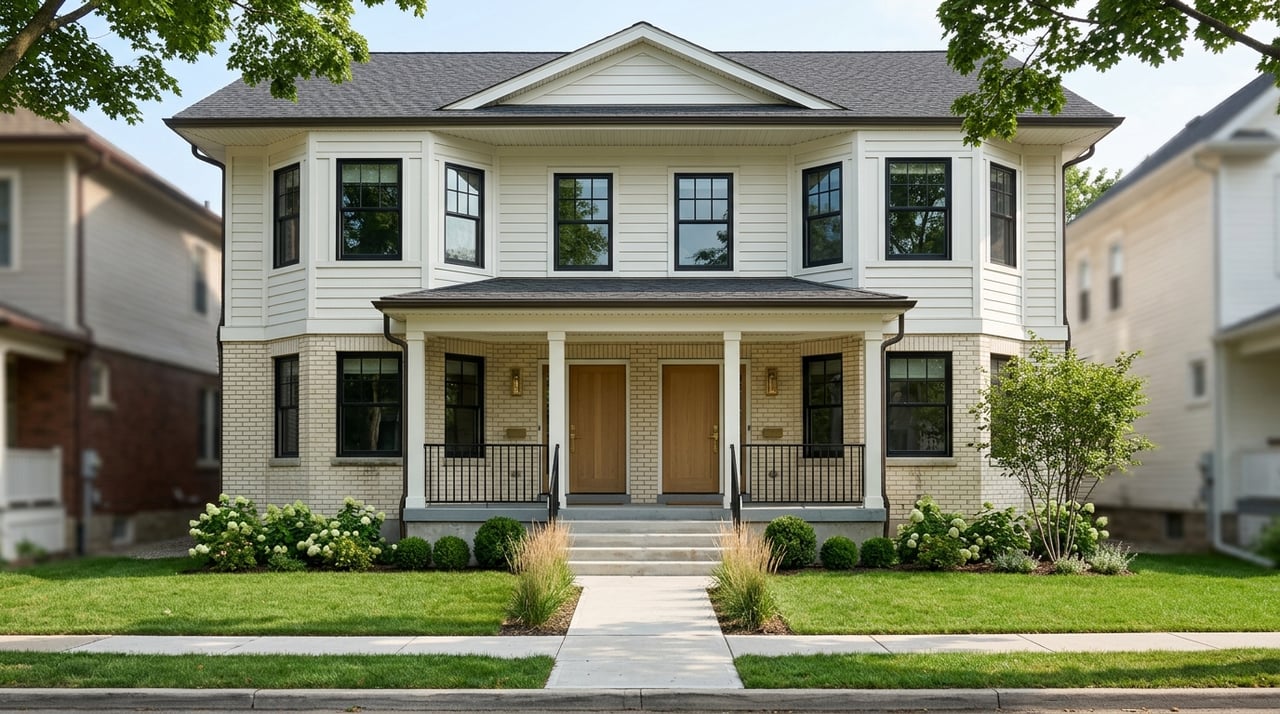
If you are thinking about buying a duplex or triplex in Milwaukee, the numbers can look promising at first glance. But a good investment is not just about a low list price or a high rent estimate. You need a clear way to test income, expenses, taxes, and building condition before you make an offer. This guide will show you how to analyze duplex and triplex investments in Milwaukee with a practical, local lens. Let’s dive in.
Why Milwaukee Stands Out
Milwaukee has a deep small multi-family housing base, which gives you more opportunities than many other cities. According to the City of Milwaukee’s 2025 Housing Affordability Report, the city has about 34,200 duplex properties, or 68,400 units, and 46% are owner-occupied.
That matters because duplexes are not a niche product here. They are a core part of the housing stock, which means buyers and investors can often find more inventory, more neighborhood variety, and more relevant sales data than in markets where 2 to 4 unit buildings are less common.
Current listing data also points to a relatively accessible entry point. Redfin’s Milwaukee multi-family page shows 229 multi-family homes for sale with a median listing price of $180,000, while the city’s report places the median assessed duplex value at $178,500.
Start With Milwaukee Price Benchmarks
Before you run returns, get your pricing bearings. Milwaukee’s duplex and triplex market appears to offer many opportunities in the $100,000 to $350,000 range based on current listings, though renovated properties or properties in certain areas may list above that.
That range is useful as a working benchmark, not a final value conclusion. Asking prices, assessed values, and closed sales are all different, so use them to frame your search and underwriting rather than to set value on their own.
It also helps to compare small multi-family pricing with the broader housing market. Redfin’s city housing market data shows Milwaukee’s median home sale price was $220,000 in February 2026, which suggests many duplex and triplex opportunities still sit at a modest entry point relative to the citywide market.
Estimate Rent Two Ways
A smart Milwaukee analysis uses both a conservative rent benchmark and a current market benchmark. That gives you a realistic range instead of a single optimistic number.
Use HUD FMR as Your Floor
For conservative underwriting, Milwaukee County’s FY2025 HUD Fair Market Rents are $1,257 for a 2-bedroom and $1,558 for a 3-bedroom. These are not meant to represent the top of the market. They are better used as a lower-bound benchmark for standard-quality rental housing.
If you are analyzing a duplex with two 2-bedroom units, that would imply about $30,168 in annual gross rent. This is a helpful stress test if you want to see whether the property still works under more conservative assumptions.
Use Current Market Rent as Your Upside Test
For a broader snapshot, RentCafe’s Milwaukee rent data shows an average city rent of $1,573, including $1,762 for 2-bedroom units and $1,972 for 3-bedroom units as of March 23, 2026.
Using that same two-unit example, two 2-bedroom units at $1,762 each would generate about $42,288 in annual gross rent. That is a big jump from the HUD-based estimate, which shows why it is important to test multiple scenarios.
Underwrite by Neighborhood, Not City Average
One of the biggest mistakes investors make is relying too heavily on citywide averages. In Milwaukee, neighborhood-level differences can change both your income potential and your risk profile.
RentCafe’s neighborhood data shows wide rent variation, from $802 in Merrill Park to $2,533 in Historic Third Ward. On the sales side, Realtor.com neighborhood pages show that different areas can also have very different listing and rent relationships.
For example, Riverwest showed a median listing price of $329,000 and median rental price of $1,345 in February 2026, while Milwaukee ZIP code 53216 showed a median listing home price of $175,000 and median rent of about $1,250. Those are very different starting points for a return calculation.
What to Compare in Each Area
When you analyze a duplex or triplex in Milwaukee, compare these local factors before you decide whether the deal works:
- Asking price versus nearby comparable properties
- Estimated rent using both HUD FMR and current market rent
- Building age and likely repair needs
- Current assessed value and tax burden
- Unit mix, such as 2-bedroom versus 3-bedroom layouts
This approach gives you a much clearer picture than relying on a citywide average alone.
Build a Simple Cash Flow Model
You do not need a complex spreadsheet to spot a strong opportunity. Start with a basic underwriting stack and keep your assumptions realistic.
Core Formula to Use
Your analysis should include:
- Gross scheduled rent
- Less vacancy and credit loss
- Effective gross income
- Less operating expenses
- Net operating income, or NOI
- Cap rate
- Cash-on-cash return if financing is involved
This structure helps you separate a property that only looks good on paper from one that can perform after real expenses.
Give Property Taxes Extra Attention
In Milwaukee, property taxes deserve special attention in your model. The city’s 2025 tax brochure lists the combined property tax rate at $20.80 per $1,000 of assessed value.
Using the city’s median assessed duplex value of $178,500, that works out to about $3,713 per year in property tax before any owner-occupant credits. For an investor, that is a meaningful operating expense and should never be treated as an afterthought.
Put another way, that tax bill would absorb about 12.3% of gross rent if you underwrite two 2-bedroom units at HUD FMR, or about 8.8% if you use the current citywide apartment average for 2-bedroom units. That range alone can have a major effect on your NOI.
Recheck Taxes After Closing
Milwaukee also performs a citywide revaluation every year, according to the assessor information cited in the tax brochure. That means your future tax bill may not stay aligned with the seller’s current number.
If you are running returns before purchase, treat current taxes as a baseline and update your assumptions after closing. This is especially important if you are buying below or above assessed value, or if you plan to renovate.
Budget More for Older Buildings
Milwaukee’s housing stock is older than many buyers expect. The city’s housing affordability report says more than 42% of housing was built before 1940, and another 32% was built between 1940 and 1959.
For duplex and triplex investors, older housing can create opportunity, but it can also create larger capital needs. Repair timelines, maintenance costs, and replacement schedules often matter more here than in newer-build markets.
Why Age Changes Your Analysis
An older building may have:
- Higher maintenance needs
- Outdated layouts or systems
- Deferred repairs from prior ownership
- More frequent capital expenses over time
The city also notes that some lower-value areas face functional obsolescence tied to age and neglect. In practical terms, that means you should reserve more capital for updates and repairs when underwriting older small multi-family properties.
Study the Micro-Market
Milwaukee’s neighborhood profiles reinforce how much building type and age vary from area to area. The city describes places like Amani/Park West, Enderis Park, Historic Water Tower, and Havenwoods as areas with older homes, duplexes, apartments, and long-established housing stock.
That does not tell you whether one neighborhood is better than another. It tells you that each micro-market has its own housing pattern, pricing logic, and maintenance expectations. For investors, that is a reminder to analyze each property in its exact local context.
A Practical Milwaukee Screening Example
Let’s say you are reviewing a Milwaukee duplex with two 2-bedroom units near the city’s median assessed duplex value.
If the property is assessed around $178,500, taxes may run about $3,713 per year using the city’s combined tax rate. If you underwrite rents at HUD FMR, annual gross rent would be about $30,168. If you underwrite at current average 2-bedroom market rent, annual gross rent would be about $42,288.
That spread gives you a useful range for testing the deal. If the property only works at the high end of the rent estimate and needs major repairs, the margin may be too thin. If it still works using more conservative rent assumptions, you may have a more durable investment.
What Strong Analysis Looks Like
A strong duplex or triplex analysis in Milwaukee should answer a few simple questions:
- Does the asking price make sense for the immediate area?
- Are your rent assumptions grounded in both conservative and current market data?
- Have you modeled taxes realistically?
- Have you accounted for the age and likely capital needs of the building?
- Does the property still make sense if your assumptions come in slightly below plan?
If you can answer yes to those questions, you are much closer to making a sound decision.
Milwaukee gives small multi-family buyers real opportunity, especially because duplexes remain such a meaningful part of the local housing stock. But the best deals are usually found by staying disciplined with rent assumptions, taxes, and repair reserves. If you want help evaluating duplexes or triplexes in Milwaukee, the Phair-Hinton Group can help you compare neighborhoods, assess opportunities, and move through the process with clear local guidance.
FAQs
How do you analyze a duplex investment in Milwaukee?
- Start with local asking price benchmarks, estimate rent using both HUD Fair Market Rents and current market rent data, then subtract vacancy, operating costs, and Milwaukee property taxes to calculate NOI and return.
What rent should you use for a Milwaukee duplex or triplex analysis?
- Use two benchmarks: HUD FMR as a conservative floor and current market rent as a higher market scenario, then test whether the deal works under both cases.
Why are Milwaukee property taxes important for duplex investors?
- Milwaukee’s combined 2025 property tax rate was $20.80 per $1,000 of assessed value, so taxes can take a meaningful share of rental income and materially affect cash flow.
Why should you analyze Milwaukee multi-family properties by neighborhood?
- Rent levels, asking prices, and housing stock vary widely across Milwaukee, so neighborhood-level analysis is more accurate than using one citywide average.
What makes older Milwaukee duplexes and triplexes different to underwrite?
- Much of Milwaukee’s housing stock was built before 1960, so older properties often require larger repair and capital reserves as part of a realistic investment analysis.