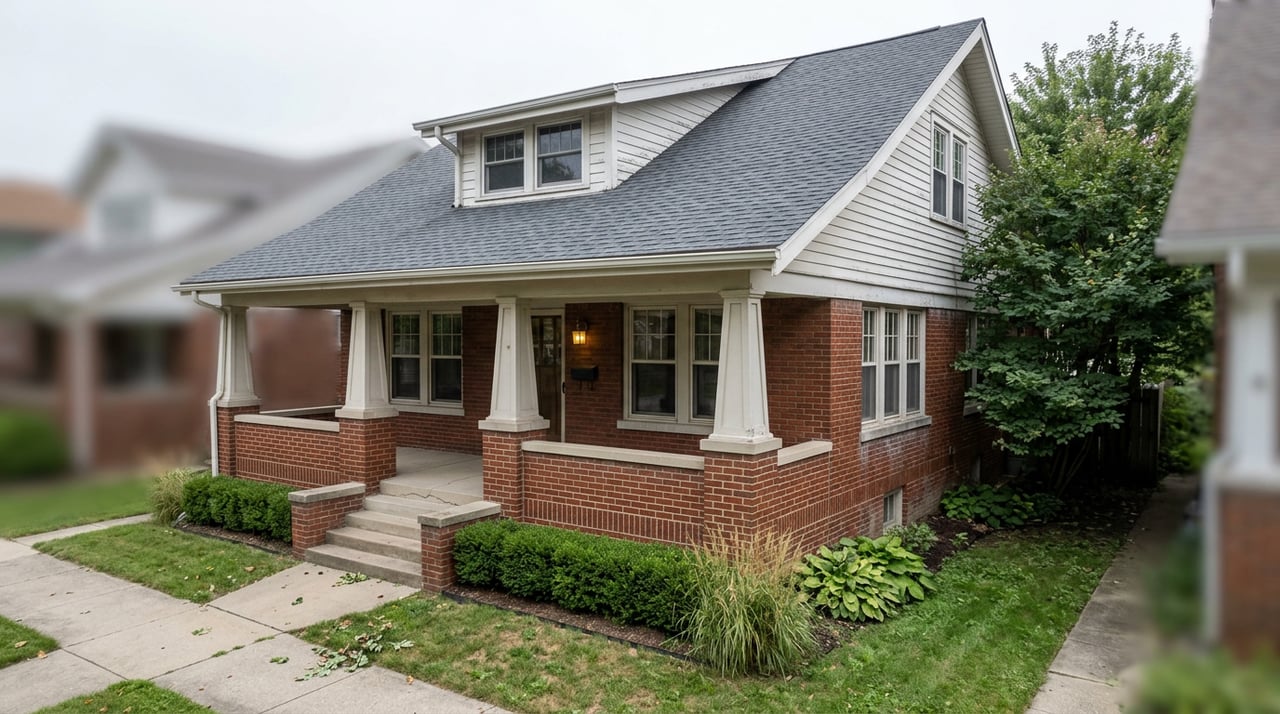
If you're cross-shopping a $550,000 house in the City of Madison against a similarly priced house six miles away in Middleton, you're probably comparing school districts, commute times, and maybe square footage. You're almost certainly not comparing how often each municipality re-values its property, because nobody puts that on a listing sheet. It should be near the top of your list. It's the single best predictor of whether your tax bill next year looks like this year's, or looks nothing like it.
Here's the plain version of what's happening in Dane County right now. The City of Madison values every taxable property in the city every single year, at 100 percent of what the assessor believes it would sell for on the open market as of January 1. Many of its neighbors don't. They run on a maintenance-and-catch-up model: most years, assessed values roll over largely unchanged, and then every so often the municipality hires an outside firm to reset everything at once. Middleton just went through one of those resets. The result was a citywide jump in total assessed value of roughly 32 percent for the 2026 assessment year. Madison's residential assessments, by comparison, rose 4.8 percent citywide for 2026, while the average Madison single-family home value climbed a slower 3.9 percent, the smallest such increase the city has recorded since before the pandemic.
Same county, same hot market, two completely different experiences of what a "tax year" feels like. That difference comes down to a habit, not a rate.
Two Ways to Keep an Assessment Roll Honest
Every Wisconsin municipality is legally required to keep its property values reasonably close to market value. State law gives them two ways to do it. One is what Madison does: revalue everything, every year, using sales from the prior calendar year to trend the whole roll forward. The city's own assessor's office describes the process directly, confirming that all property is valued annually at 100 percent of market value as of January 1. For 2026, that meant a citywide increase in locally assessed real estate of 6.1 percent, with commercial assessments up 8.3 percent and residential up 4.8 percent, and an average single-family home value that rose to $500,300.
The other path is the maintenance model. Fitchburg is explicit about which track it's on in a given year. For 2026, the city described its work as a "maintenance assessment roll," noting plainly that during maintenance years, most property assessments stay the same. Middleton, on the other hand, had gone long enough without a full reset that it brought in Associated Appraisal Consultants to complete a citywide revaluation for 2026, explicitly to bring every property back to 100 percent of current market value in one pass. That's the mechanism behind the 32 percent jump. It wasn't the market suddenly getting hotter in Middleton than in Madison. It was years of accumulated gap between assessed value and market value landing on homeowners in a single tax year instead of being spread across several smaller ones.
The Wisconsin Policy Forum's research on this exact pattern found that only 39 percent of municipalities, 735 in total, completed a revaluation over an 11-year span. Most run on the maintenance model most of the time, which means most Dane County suburbs are carrying some amount of unrealized gap between what the assessment roll says and what the market actually says, waiting for the year it gets closed.
| Municipality | 2026 assessment approach | Result |
|---|---|---|
| City of Madison | Annual, full value, every parcel | Residential assessments up 4.8%, commercial up 8.3% |
| City of Middleton | Citywide revaluation after a multi-year gap | Total assessed value up approximately 32% |
| City of Fitchburg | Maintenance roll, most values unchanged | Most property assessments stayed flat |
Who Actually Feels the Catch-Up
A revaluation year doesn't automatically raise the total amount of tax collected. Middleton's own notice to residents makes that point directly, explaining that a reassessment changes how the tax burden is distributed among properties, not the total levy the city needs to raise. What it does is redistribute who pays what share, and that redistribution tends to hit hardest in the neighborhoods that appreciated fastest since the last full reset. The Wisconsin Policy Forum flagged this specifically for growing Madison-area suburbs: a newer subdivision that gets reassessed more often can end up carrying an outsized share of the tax base, while an established neighborhood that hasn't had a fresh look in years can be paying less than its current market value would suggest.
That's the part a median list price will never tell you. Two houses at the same price point in two different towns can be starting from very different points in that catch-up cycle, and you won't know which one you're buying into unless you ask.
Madison's own assessor's office described the mechanics of the annual approach when it sat down with the local paper, Isthmus, for a reader Q&A on the process. Business systems manager Megan Lukens explained the trending method the office uses to keep pace with a market that moves faster than the calendar allows: "We're usually under sale prices," she said, describing how the office applies a trend to unsold properties based on the prior year's closed sales. That's a deliberate lag built into an annual system. A maintenance system carries a longer, less predictable lag until the year the gap gets closed all at once.
The Spread Doesn't Stop at the City Line
Even inside Madison, the tax bill isn't one number. Effective property tax rates vary by ZIP code depending on which school district and special assessment districts overlap a given parcel. Median effective rates run from about 3.56 percent in the 53704 ZIP to about 3.76 percent in 53726, a spread of two-tenths of a percentage point that translates into a real dollar gap on a comparable home. County-wide, the range is much wider. Madison currently carries the highest median property tax bill in Dane County at $12,519, while Edgerton sits at the low end around $3,975. Dane County's overall median bill of $8,224 is more than three times the national median of $2,400, which is worth knowing before you get attached to a number you saw on a national portal.
None of this is a reason to avoid Madison or any particular suburb. It's a reason to ask a more specific question than "what's the mill rate" when you're comparing towns.
What to Ask Before You Compare Two Tax Bills
If you're weighing a house in the City of Madison against one in a neighboring Dane County community, the current year's assessed value and mill rate only tell you where things stand today. The more useful question is when that municipality last completed a full revaluation and whether it runs on an annual or maintenance schedule. A town that just finished a reset, like Middleton in 2026, is likely to be close to current market value for a while. A town several years into a maintenance cycle could be sitting on a gap that shows up all at once, in a year you didn't plan for.
Municipal assessor's offices will answer this question directly if you call and ask, and it takes less time than requesting a second showing.
Does a reassessment always mean a higher tax bill? Not by itself. A reassessment resets how the total tax burden is divided among properties in a municipality, not the total amount collected. Your bill can still rise, fall, or stay flat depending on how your property's value moved relative to everyone else's.
Is Madison's annual approach unusual in Dane County? It's one model among several, and state-level research suggests it's the less common one. Most Wisconsin municipalities studied over the past decade did not conduct a full revaluation in any given year, relying instead on maintenance rolls between periodic resets.
Where do I find a town's assessment schedule before I make an offer? Every Dane County municipality's assessor's office publishes its current-year assessment calendar, including whether the year is a maintenance roll or a revaluation. It's public information and a five-minute phone call.
Comparing two Dane County towns on price alone leaves out the part of the math that shows up eighteen months after closing. If you're weighing a move across Madison's city line, or into it from somewhere else in Wisconsin or from Illinois, that's exactly the kind of local mechanic worth walking through before you write an offer. Phair-Hinton Group works both sides of that line every week. Let's get you home, schedule a call to get started.